
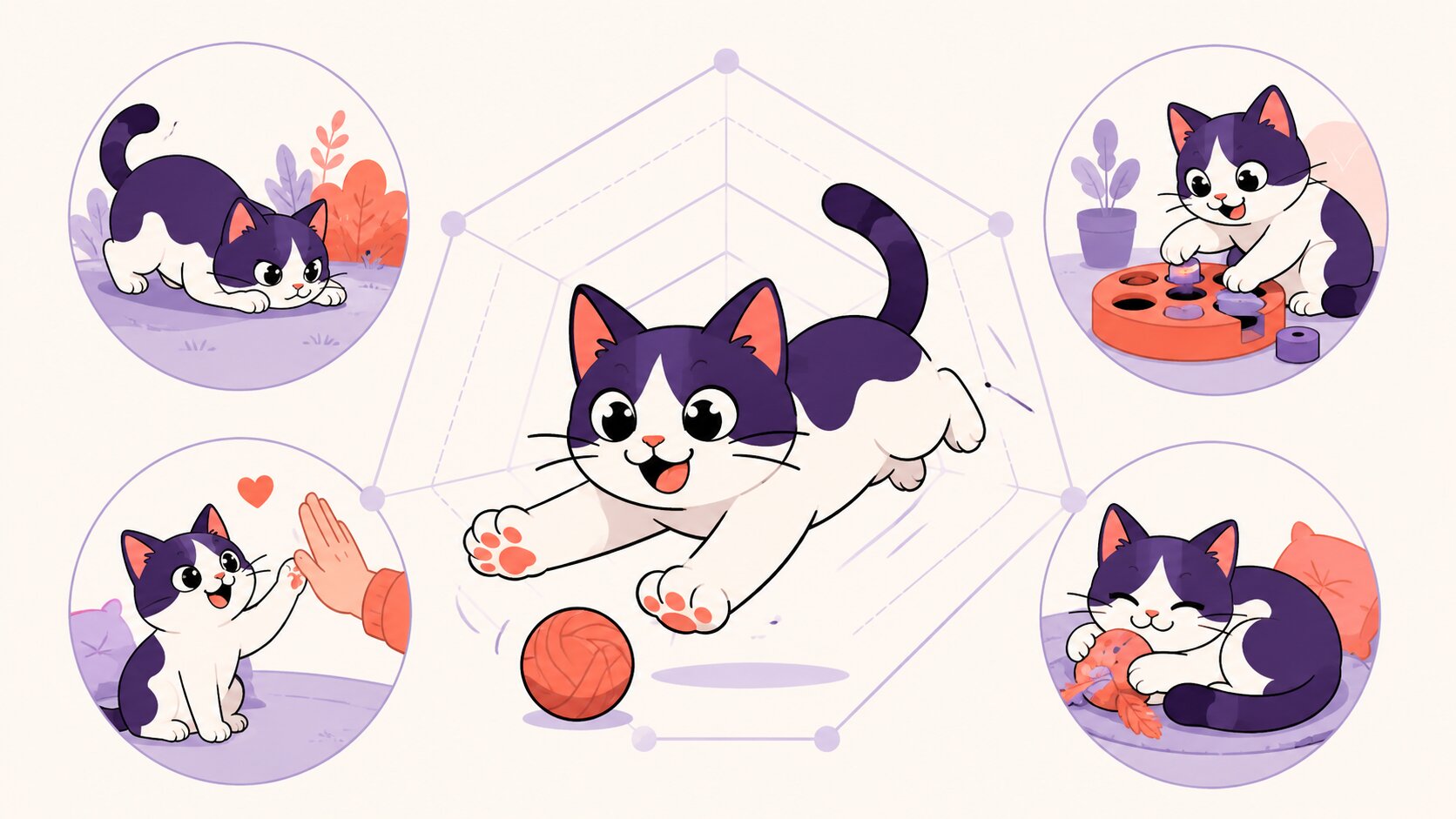
Watch a handful of cats play for five minutes each and you'll notice they don't all play the same game. One launches herself at anything that moves. Another ignores the toy entirely and just wants you holding the other end of the string. A third solves a treat puzzle in under a minute, then loses interest the second it stops being a challenge. These aren't quirks, they're patterns, and they tend to hold up across dozens of toys, not just one.
Veterinary behavior resources describe play as one of cats' core species-typical behaviors, closely tied to their natural predatory sequence of stalking, chasing, pouncing, and "catching" (VCA Animal Hospitals - Cat Behavior and Training: Play and Play Toys). But which part of that sequence a given cat gets the most out of varies a lot from cat to cat. That's the root of what we'd call a play style.
A few common play styles
The hunter
Lives for the chase. Erratic movement, feathers, anything that darts unpredictably. Loses interest fast in toys that just sit there, no matter how well-made they are.
The puzzle solver
More interested in figuring a toy out than chasing it. Treat mazes and puzzle feeders hold attention where a plain toy mouse won't. Often gets bored quickly once a puzzle's been "solved" a few times.
The co-star
The toy is almost beside the point, this cat wants a play partner. Wand toys and anything that involves a human on the other end tend to land far better than anything left on the floor solo.
The independent operator
Plays best alone, sometimes literally only when no one's watching. Toys that don't require a human to activate them, batting toys, springs, tunnels, tend to get the most use.
The connoisseur
Extremely specific about texture and sound. Crinkle or nothing. Faux fur or nothing. Loves a very narrow band of toys and ignores everything outside it, sometimes including toys that look nearly identical to the ones they love.
Why this matters more than "best cat toys" lists
Generic best-of lists rank toys by average popularity, which tells you what a lot of cats liked, not what yours will. A hunter and an independent operator can both be perfectly normal, healthy cats with completely different toy drawers, and a toy that thrills one can sit untouched with the other.
This is exactly what PounceMatch's Purrsonality Profile is built to surface. As you add toys your cat has already tried, and note what they loved, ignored, or destroyed, a shape starts to form, literally, on a radar chart, across traits like hunter instinct, independence, and sensory curiosity. Once there's enough data, it gets summarized into a fun, shareable archetype (things like "The Stealth Hunter" or "The Diva") that's really just a friendly label on top of a rules-based read of your cat's actual play history.
Figuring out your own cat's style
You don't need an app to start noticing this, five minutes of watching which toys your cat gravitates toward (and which ones they walk past every single time) is usually enough to spot the pattern. The AAFP/ISFM environmental needs guidelines note that play and predatory behavior are core needs that should be met in ways suited to the individual cat (AAFP and ISFM Feline Environmental Needs Guidelines), not a one-size-fits-all shopping list.
If you want the pattern mapped out for you instead of eyeballing it, add a toy or two on PounceMatch and see which archetype your cat lands on. It's a fun result either way, and the recommendations that come out of it are built from the same read on your cat's play style.