
Most cat toy safety issues aren't about the toy being poorly made, they're about what happens after weeks of enthusiastic biting, batting, and dragging. A perfectly safe toy on day one can turn into a hazard by week six. Here's what's actually worth checking, based on guidance from Cornell University's Feline Health Center and the ASPCA, not just general caution.
The big one: strings, feathers, and anything that can pull apart
Cornell's Feline Health Center specifically calls out toys with small pieces or linear, strand-like parts, feathers and string among them, as a risk once those parts separate from the toy and get swallowed (Cornell Feline Health Center - Safe Toys and Gifts). This is worth taking seriously. Ingested string in particular can cause a linear foreign body obstruction, which is a real veterinary emergency, not a minor stomach upset.
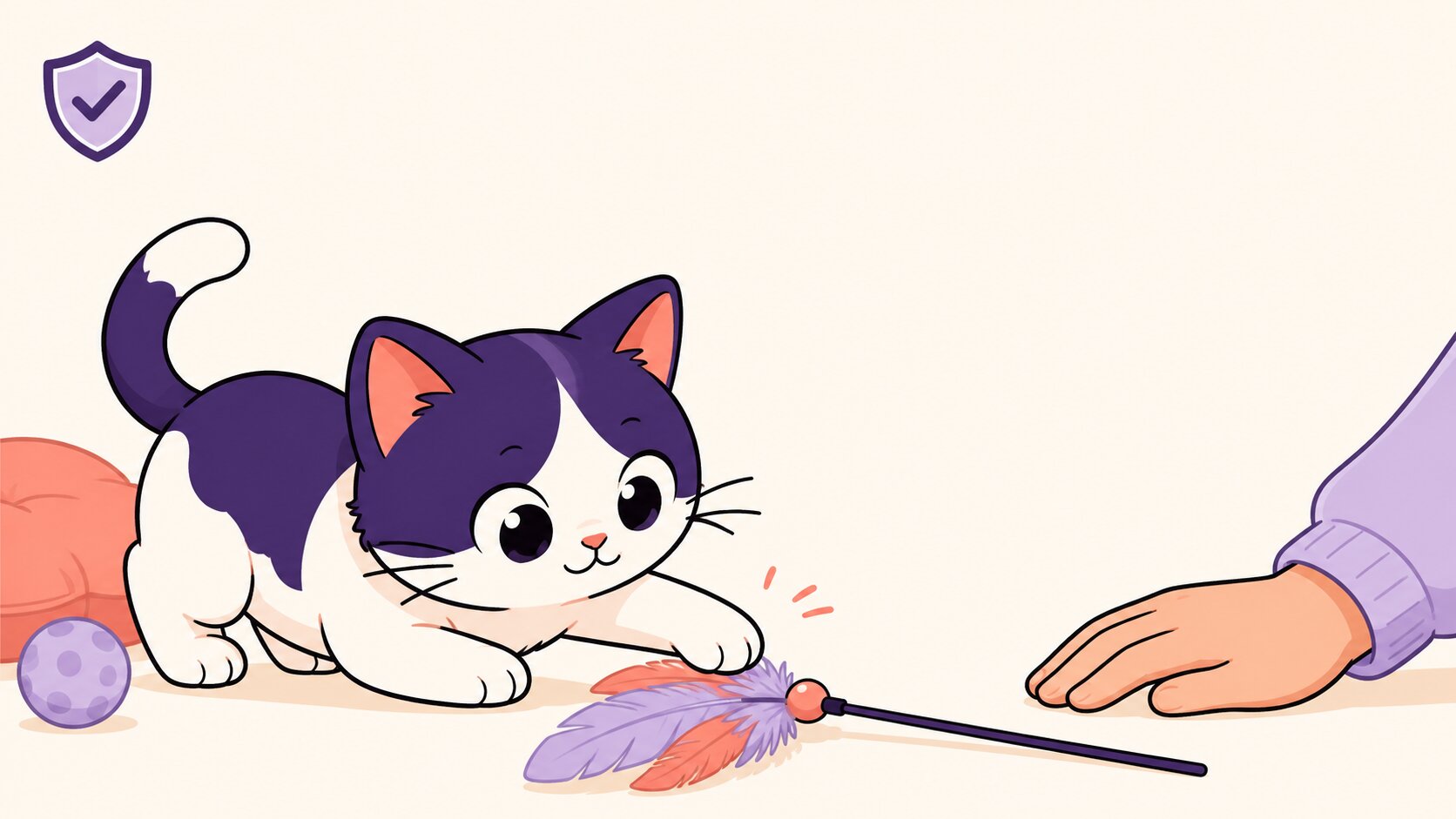
In practice, that means: wand toys, ribbon, shoelaces, and anything with loose thread should come out only during supervised play, and go back in a drawer the second play is over. Never leave string-type toys out for unsupervised access, even for a "quick" errand.
Check toys the same way you'd check a kid's toy
Small, hard, chewable pieces (plastic eyes, bells, battery covers) are the second most common issue. If a piece can come off with sustained chewing or a hard bat against a wall, assume eventually it will. Cats with a strong chew drive need tougher construction than cats who mostly bat and carry.
Anything electronic deserves an extra look too. Cornell's guidance also flags electrical cords as something to keep away from cats who chew, and the same logic applies to charging cables on any battery-powered or rechargeable toy.
Household items make great toys, with the same rules
Cardboard boxes, paper bags with the handles cut off, and crinkled-up paper are genuinely good, free enrichment, the ASPCA's own enrichment guidance leans on exactly these kinds of household items (ASPCA - Feline DIY Enrichment). But the same supervision rules apply: remove handles and drawstrings first, and keep an eye out any time plastic wrapping or packaging is involved, since sheet plastic is a suffocation and choking risk in a way that's easy to underestimate. If you use PounceMatch's household toy suggestions, you'll notice the ones with real risk (loose string, plastic wrap, small batting objects) carry a specific safety note for exactly this reason.
A short, practical checklist
- Feathers, string, ribbon, and wand toys: supervised play only, put away afterward.
- Small hard parts (bells, eyes, battery covers): check regularly for looseness, especially with heavy chewers.
- Electronic or battery-powered toys: inspect cords and casings, keep charging cables out of reach.
- Plastic bags or wrapping: fine to bat around under supervision, discard the moment it starts to tear.
- Anything new: watch the first few sessions before leaving your cat alone with it.
None of this replaces your vet
General safety guidance like this is useful for day-to-day decisions, but it isn't veterinary advice, and every cat's chewing habits, health history, and risk tolerance are different. If your cat has already swallowed something they shouldn't have, or you're not sure whether a specific toy is appropriate for a health condition, that's a conversation for your veterinarian, not a blog post.
Once you know what to avoid, the fun part is figuring out what your cat will actually enjoy within those limits. That's the part PounceMatch is built for, every recommendation shows a plain safety note when one applies, right alongside the match.