
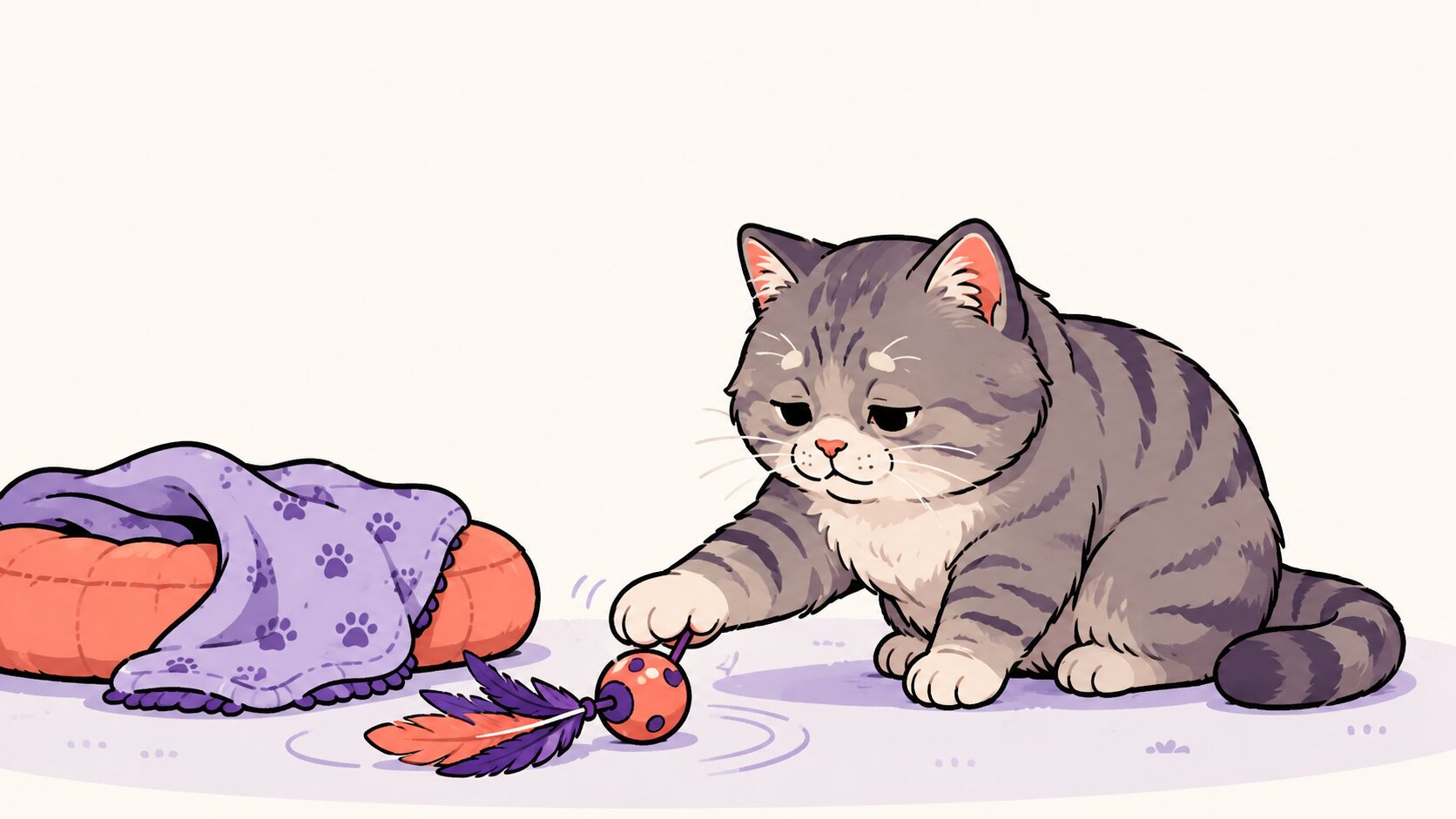
A cat who used to launch off the floor after a wand toy and now watches it swing past without much interest hasn't necessarily lost their personality. Something more specific is usually going on, and it's worth understanding before writing it off as "just getting old."
It's often discomfort, not disinterest
Cats are exceptionally good at hiding pain, a trait that made sense for a solitary wild ancestor where looking vulnerable was a real liability, and that instinct hasn't gone anywhere in the transition to living on a couch. According to the AAHA/AAFP Feline Life Stage Guidelines, degenerative joint disease often shows up first as a reduction in jumping or climbing, not as an obvious limp the way it might in a dog. A cat who's quietly sore is far more likely to just stop chasing things than to show any clear sign that something hurts.
The ASPCA's guidance on behavior changes in older cats makes a similar point from a different angle: it's a mistake to assume any behavior change is "just age" without ruling out a treatable medical cause first. Reduced interest in play is exactly the kind of change worth mentioning at a vet visit, not something to quietly work around.
What's actually changing
- Joint comfort. Pouncing, jumping, and quick direction changes all load the joints in ways a slower stalk-and-swat doesn't. A cat with early arthritis often keeps hunting instincts fully intact, they just can't act on them the same way physically.
- Vision and hearing. A toy that relies on fast, erratic motion across the room may simply be harder to track than it used to be. Slower, closer-range movement can still land well.
- Energy budgeting. Older cats often shift toward shorter, lower-intensity bursts of activity rather than the sustained chase sequences a younger cat sustains easily.
- Confidence. Sensory changes can make a cat startle more easily or feel less sure of a jump they'd have taken without hesitation before, which shows up as reluctance long before it shows up as a visible mobility problem.
Reporting on senior pet behavior from the American Veterinary Medical Association makes the same case veterinary behaviorists keep returning to: new behavior changes in an older cat should get looked at through the lens of pain and medical causes first, rather than assumed to be simple personality drift.
What still works, and what to adjust
None of this means play should stop, it just needs to meet the cat where they actually are now, not where they used to be.
- Bring play down to floor level instead of encouraging jumps onto furniture or cat trees.
- Shorter, more frequent sessions tend to land better than one long one that asks for sustained sprinting.
- Slower, closer, more deliberate movement often gets a stronger response than fast, erratic motion across a room.
- Puzzle feeders and low-impact batting toys keep the mental side of hunting engaged without the physical strain of a full chase.
- Watch for hesitation before jumps or a change in which surfaces they'll use, both are worth mentioning at their next vet visit.
Building a profile that actually accounts for this
This is exactly why age stage is part of a cat's profile on PounceMatch from the start. A senior cat and a kitten can have completely different play needs even with similar personalities underneath, and matching recommendations to actual energy level and play style matters more as that gap widens. If your cat's routine has shifted, updating their profile helps keep recommendations aligned with the cat they are now, not just the one they used to be.
This article is general information, not a substitute for veterinary care. A sudden or significant change in play, mobility, or activity is worth a vet visit to rule out a treatable cause before assuming it's simply age.