
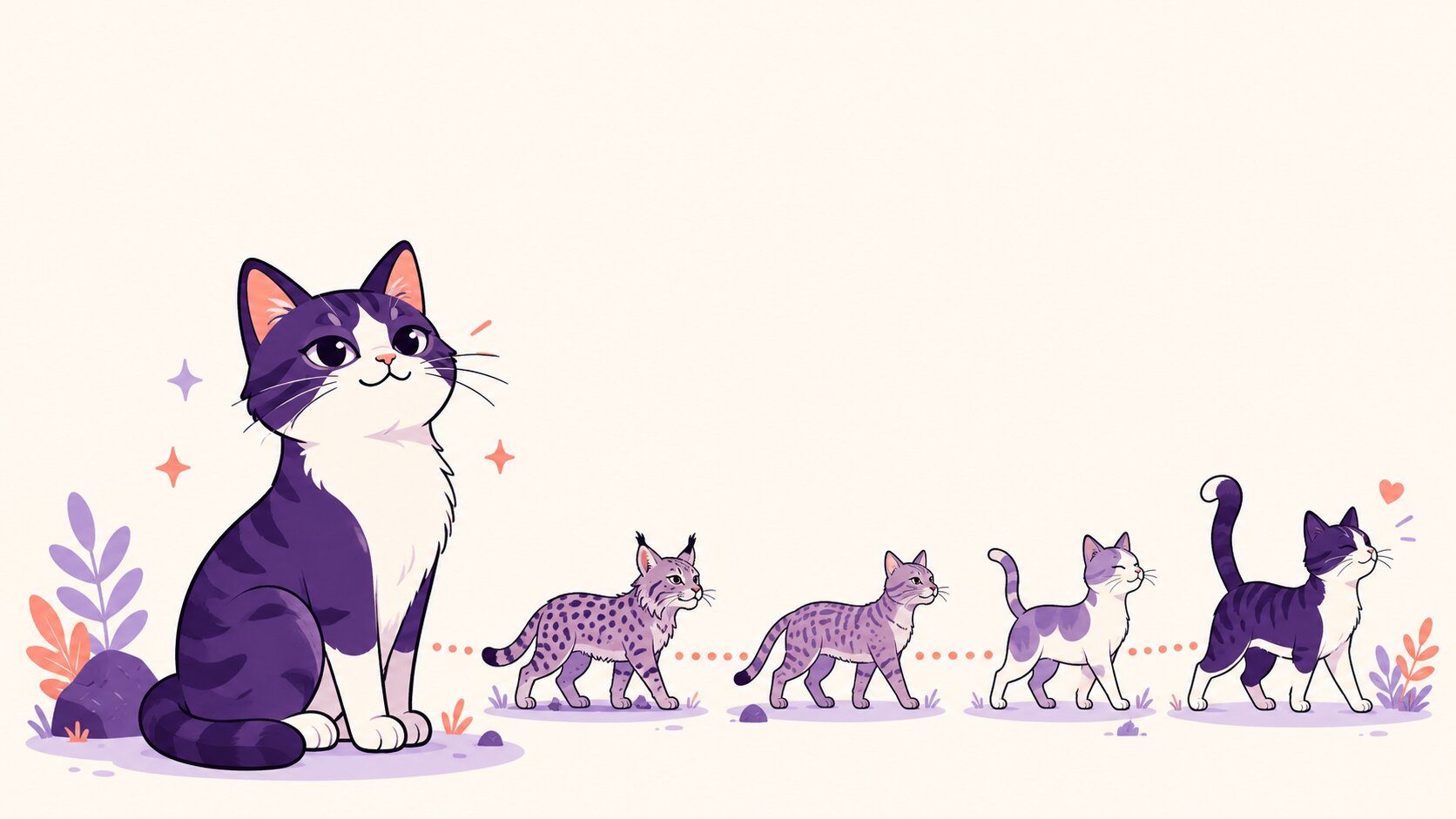
Look closely at an orange tabby, and you're looking at a pattern that predates agriculture. It predates cities. It predates the wheel. The M-shaped marking across your cat's forehead, the faint stripes down their sides, even in a cat whose coat looks solid at first glance, trace back to the exact same markings carried by the wild ancestor every single domestic cat on Earth descends from.
That's not a metaphor. It's genetics, and it's a big part of why the reflection in PounceMatch's Big Cat Portrait feature doesn't feel like a costume. The resemblance was already there.
One wildcat, one lineage, one very old pattern
Every domestic cat alive today, from a hairless Sphynx to a fluffy Maine Coon, descends from a single wild subspecies: the African wildcat, Felis lybica lybica. Genetic research summarized by National Geographic traced this by comparing DNA across wildcat subspecies from Europe, Central Asia, southern Africa, and China, and found that domestic cats consistently matched the genetic lineage of the Near Eastern and North African wildcat, not any of the others. That lineage is thought to stretch back 70,000 to 100,000 years, long before anything resembling domestication began.
Domestication itself came later and more gradually than most people assume. Rather than being tamed and selectively bred the way dogs were, cats largely domesticated themselves: wildcats drawn to the rodents gathering around early grain stores, and the calmest, least fearful individuals thriving closest to people. Newer DNA analysis of ancient cat remains, covered by National Geographic's coverage of a 2017 genetics study, found that cats changed remarkably little from their wild ancestors during this process, aside from one notable exception: the tabby pattern itself became more pronounced over time.
Why the resemblance is still visible today
The African wildcat and its close relatives (the European wildcat and the Asiatic wildcat) all share the same underlying coat: sandy to grey-brown, faint mackerel striping, a black-ringed tail. That's the template every domestic tabby pattern, mackerel, classic, spotted, or ticked, is a variation on. According to the Library of Congress's overview of cat domestication research, this lineage traces to wildcat populations in the Fertile Crescent and ancient Egypt, the same regions where cats first began living alongside people.
Coloring diverges further from there. A cat with dense black pigment reads closer to a panther. Warm orange and gold tones echo a tiger or a lion. Spotted patterns point toward a cheetah. Cool grey tones with tufted-looking features suggest a lynx. None of this is precise taxonomy, real big cats aren't just oversized tabbies, but the visual family resemblance is genuinely rooted in shared ancestry, not just surface-level color matching.
Seeing it for yourself
This is exactly the idea behind Big Cat Portrait: upload a photo of your cat, and it studies their actual coloring and markings to generate a portrait of them looking into a mirror, reflecting the big cat their pattern most resembles: tiger, lion, cheetah, cougar, lynx, or a general wildcat match. It's not a random filter. The species it picks is based on your cat's real coat, the same visual traits that trace back to that shared ancestor.
It's free to try, the first three portraits on any account don't cost anything, and it takes about a minute. If you've ever looked at your cat mid-stalk, locked onto a toy like it personally wronged them, and thought that's not a house cat face, that's a predator face, you were more right than you knew.
And if you want to see what that same intensity looks like when it's actually productive, rather than aimed at a sock, start your cat's Purrsonality Profile and see which toys match the hunter they clearly still are underneath.