
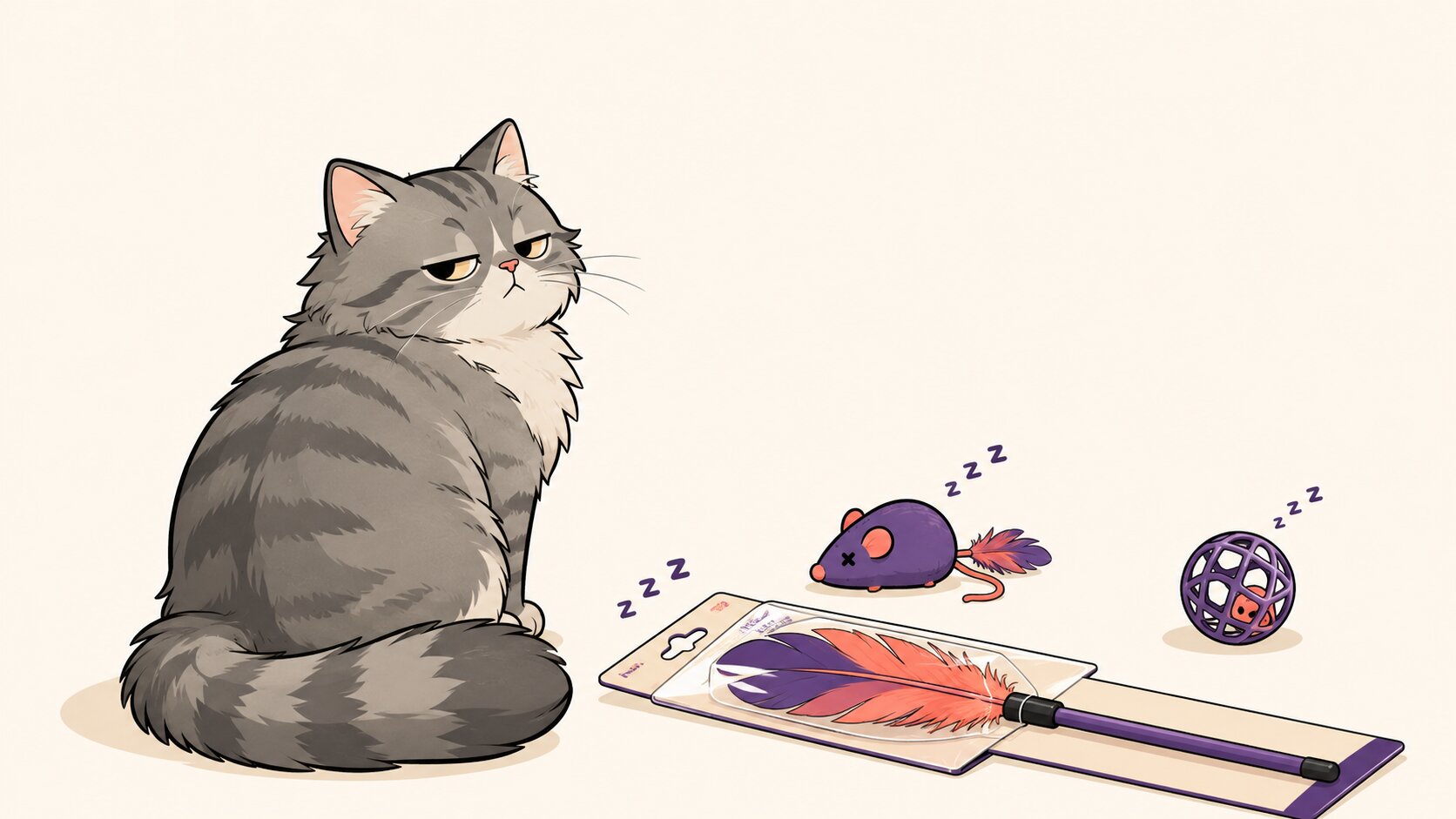
You did everything right. You read reviews, picked something highly rated, maybe even paid extra for the one with good photos of cats actually using it. Your cat sniffed it once, gave you a look, and walked away. It's still sitting there, untouched, three weeks later.
This is possibly the most common complaint in cat ownership, and it isn't a sign you did anything wrong. It's a sign the toy industry is built around what looks appealing to humans in a store aisle or a product photo, not around what any individual cat actually wants.
Cats don't have generic preferences, they have specific ones
A study of enrichment preferences in laboratory-housed cats found that individual cats had clear, distinct preferences between different play options, and that those preferences didn't line up neatly by any obvious category (Enrichment Preferences of FIV-Infected and Uninfected Laboratory-Housed Cats). Some cats went straight for a wand toy, others were far more interested in being brushed or petted than any object at all. The preference was individual, not universal.
That tracks with basic cat behavior. A toy your cat ignores usually isn't failing at "being a cat toy" in general, it's failing to match the specific combination of traits that particular cat responds to: how it moves, what it feels like, whether it makes noise, whether your cat has to chase it down or it comes to them.
What's actually going on when a toy gets ignored
- Wrong movement. Some cats are triggered by erratic, unpredictable motion (a real mouse doesn't move in a straight line). A toy that just rolls in one direction can read as boring, not scary or exciting, just uninteresting.
- Wrong texture or sound. A cat drawn to crinkle sounds may have zero interest in a silent plush toy, even one shaped like prey. Sensory details matter more than the overall toy category.
- No task to complete. Predatory play has a sequence: stalk, chase, pounce, "kill." A toy that can't be caught, or offers no resolution, can lose a cat's interest fast.
- Timing. A toy left sitting out stops registering as prey and starts registering as furniture. Even a toy your cat loves can go stale if it's never put away and reintroduced.
The fix isn't a better toy, it's a better match
Once you notice a pattern (say, your cat only cares about toys that crinkle and roll, and ignores anything stationary and plush) you can stop buying at random. This is the entire idea behind PounceMatch: instead of guessing again, you tell it what your cat already loves, likes, ignores, or destroys, and it looks for the traits underneath those reactions rather than the product category. Two toys that ignored can look completely different on a shelf, and still fail for the exact same reason.
If you want to see this in practice, start with one toy your cat already has an opinion about. The pattern usually shows up faster than you'd expect, and it only gets clearer with every toy you add.
A quick gut check before buying the next one
Before your next purchase, it's worth asking what specifically your cat responded to in the toys they've already loved, not what worked for a cat in a review video. The AAFP and ISFM Feline Environmental Needs Guidelines put it plainly: meeting a cat's environmental and play needs is species-specific and individual, not one-size-fits-all. Buying toys at random works against that. Matching to what your own cat has already told you, through what they play with and what they walk away from, works with it.