
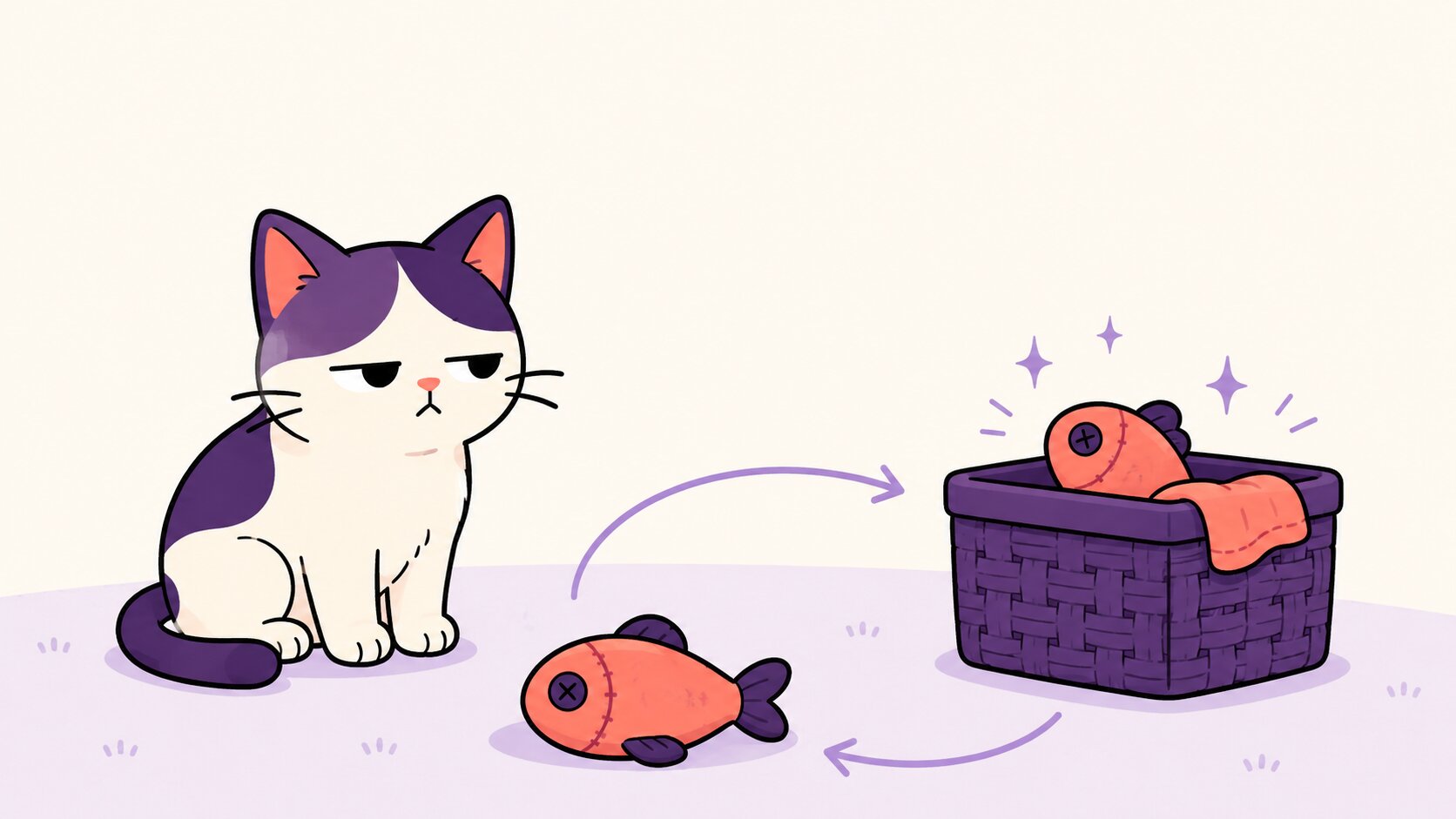
A toy your cat obsessed over three weeks ago is now, functionally, part of the floor. They step over it. They don't even look at it anymore. Nothing changed about the toy, it's the same crinkle, the same feathers, the same everything. What changed is your cat.
The actual mechanism: habituation, not boredom
The behavioral term for this is habituation: repeated exposure to the same unchanging stimulus causes a cat's response to it to fade, even when nothing about the stimulus itself has gotten worse. It's not a character flaw or a sign your cat is spoiled. It's the same reason a ticking clock disappears from your awareness after a few days in a new house. A toy that never moves, never gets put away, and never surprises them eventually stops registering as anything worth a reaction.
Predatory play only works as enrichment when there's some unpredictability to it, which is exactly why organizations like the San Francisco SPCA specifically recommend rotating toys as part of a healthy play routine, right alongside things like climbing perches and window access. It's not a minor tip, it's treated as a core part of keeping an indoor cat's environment genuinely stimulating.
What rotation actually does
Putting a toy away for a while and reintroducing it later doesn't reset the toy, it resets your cat's response to it. The same toy that got ignored in week three can get a full reaction again in week five, purely because it's been out of sight long enough to stop being background noise. VCA Animal Hospitals' guidance on enrichment and activity toys frames this the same way zoos and shelters think about behavioral enrichment for any species: novelty itself is part of what makes something engaging, not just the object.
This is also why buying an entirely new toy every time interest fades isn't actually necessary, and can get expensive fast. Rotation gets most of the benefit of novelty without the ongoing cost, because from your cat's perspective, a toy that's been missing for a week and a toy that's brand new aren't that different.
A rotation schedule that actually holds up
- Keep 3 to 4 toys accessible at a time. Too many options at once creates its own kind of visual clutter that can make it harder for a cat to focus on any single one.
- Store the rest out of sight, not just out of reach. A toy visible on a shelf still registers as "there." It needs to actually disappear from the environment to reset.
- Rotate every few days to a week, faster for a cat who habituates quickly, slower for one who's still actively interested. There's no universal number, watch the actual response.
- Mix categories, not just toys. Swapping one feather wand for a nearly identical feather wand doesn't add much novelty. Alternating between movement types, chase toys, puzzle feeders, batting toys, gives a bigger reset than swapping within the same category.
- Refresh catnip or silvervine toys when you bring them back. Scent fades faster than the toy itself stops being interesting, and a quick top-up can make a stored toy feel new again on its own.
Rotation solves staleness, not mismatch
It's worth being honest about what rotation can and can't fix. If a toy gets ignored on day one, before habituation ever had a chance to set in, that's usually not a novelty problem. That's a mismatch between the toy and what your cat actually responds to , wrong texture, wrong movement, wrong pace, and no amount of rotating it in and out is going to fix that. Rotation keeps toys your cat already likes feeling fresh. It doesn't turn a toy they never liked into one they suddenly will.
That distinction is exactly what PounceMatch's Purrsonality Profile is built around. Every toy you rate teaches it more about which specific traits your cat responds to, so the recommendations it surfaces are toys worth rotating into the mix in the first place, not just more things to add to a pile that gets ignored just as fast.