
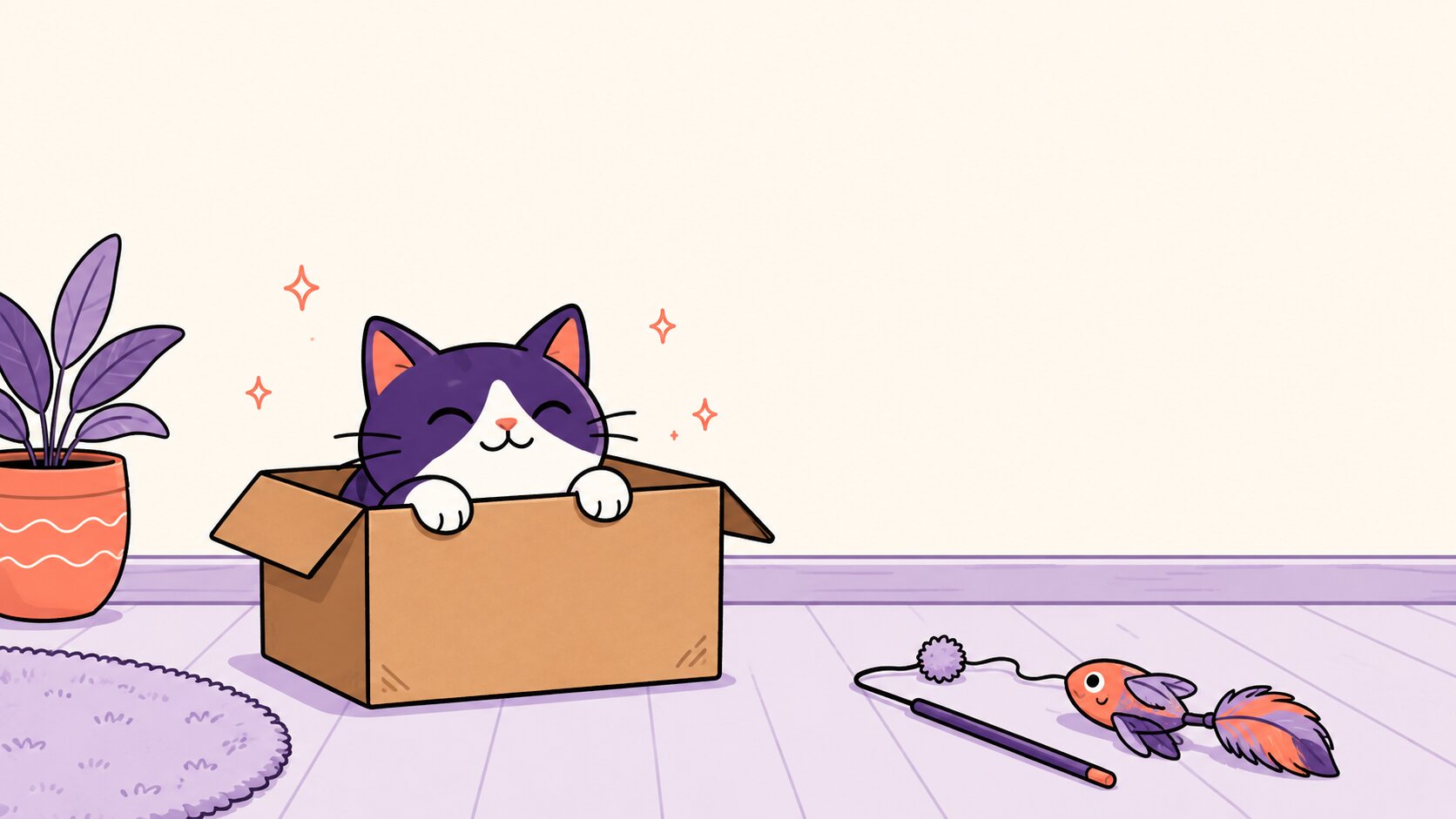
You research it. You compare reviews. You pay real money for it. And your cat spends the next three days sitting inside the box it arrived in, ignoring the toy completely. If this feels personal, it isn't. It's one of the most consistent, well-documented patterns in cat behavior, and there's actual published research explaining exactly why the box wins.
The box isn't a joke, it's measurably doing something
Researchers at Utrecht University ran a controlled study on newly arrived shelter cats, giving half of them a simple cardboard hiding box and leaving the other half without one. Using a standardized feline stress scoring method, the study, published in PLOS ONE, found that cats with access to a box recovered from the stress of a new environment measurably faster, with a significant difference showing up within three to four days, than cats without one. This built on earlier work from the same research group establishing that hiding opportunities specifically, not just having "stuff" in the enclosure, were driving the effect.
That's not a cute anecdote, it's a controlled trial with a measured physiological outcome. A box gives a cat something most toys never will: full enclosure, a controllable entrance, and the ability to disappear from view entirely. Hiding is a real coping strategy for cats, not a personality quirk, and a box satisfies it in a way that a wand toy or a plush mouse structurally cannot.
Price was never the variable that mattered
It's tempting to read "my cat prefers the free box" as evidence that expensive toys are a scam. That's not quite it either. The actual research on cat enrichment points somewhere more specific: individual cats have real, distinct preferences that don't track with what a toy costs or how it's marketed. A study on enrichment preferences in laboratory-housed cats found that some cats gravitated strongly toward one specific type of object over others, and that preference varied cat to cat, not by price point or design complexity (Enrichment Preferences of FIV-Infected and Uninfected Laboratory-Housed Cats). A $30 toy optimized to look good in a product photo isn't optimized for your specific cat's actual sensory preferences. A box, unglamorously, happens to hit several of them at once: texture, enclosure, sound, and a shape that rewards exploring.
The ASPCA's own enrichment guidance leans on exactly this insight, recommending household items like boxes and paper bags as genuine, not consolation-prize, enrichment (ASPCA - Feline DIY Enrichment), not as a cheaper substitute for "real" toys but as legitimately effective on their own terms.
What the box is actually doing right
- Full enclosure. Most toys are designed to be chased or batted in the open. A box offers the opposite: a controllable, low-visibility space, which taps directly into the stress-reduction effect the Utrecht research measured.
- An entrance a cat controls. Cats can enter, exit, and adjust their exposure on their own terms, unlike a toy that's fully accessible (or fully inaccessible) all the time.
- Texture and sound. Cardboard has a specific scratch resistance and sound profile some cats are drawn to independent of anything else going on with the toy.
- Zero pressure to "perform." A box doesn't ask anything of a cat. It's there to be used however they want, whenever they want, which matters more for some cats than any single feature a purpose-built toy offers.
What this actually means for what you buy next
The lesson isn't "stop buying toys," it's that price and marketing were never reliable signals for match quality in the first place, and the box is proof of that, not an exception to it. This is exactly the same underlying issue behind most toys getting ignored on arrival: a mismatch between what a toy offers and what a specific cat actually responds to, regardless of how much it cost.
It's also why household items sit right alongside purchasable toys in PounceMatch's recommendations, not as filler, but because they're scored the same way: by the actual traits your cat has responded to, texture, movement, containment, sound, not by price tier. If your cat has strong opinions about boxes, bags, or wrapping paper, rating those experiences teaches the system exactly as much as rating a $30 toy does, sometimes more.